Monday, August 22, 2016
DEVELOP THE ART OF PHOTOGRAPHY
A typical magazine journalist is expected to develop the skill of creating interesting photography to illustrate his/her stories for magazines. Photography is tied deeply to becoming conscious of the sky, the weather, the lands that surround you. The image above is from California near Palm Springs, where towering mountains separate the maritime and the desert worlds. In a recent trip the clouds were hypnotic. Above gentle clouds danced across the blue sky, even as menacing dark and dangerous-looking systems climbed over the mountain tops to threaten the terrain facing me, looming higher in the blue sky every moment The darkening scene turned the foreground into a silhouette. What would happen? Would a clap of thunder precede a sudden rain? The movement of the clouds and the distant clamor of natural electrical systems told their story. Before long the clouds had risen to cover the sky above and create a breathless feeling like the impending rise of a theatre curtain on some drama. Yes, this would be a photograph that would move future viewers of a magazine story.
Photos tell your story without captions. They set the stage for events you will relate. The mood of your artile's focus. Look, Listen. Imagine.
Friday, July 15, 2016
THE ISLAND IN THE COLUMBIA RIVER THAT WASN'T
In the early 1900s a Russian immigrant, Alexander Zuckerberg, came to the Castlegar BC area of British Columbia as a teacher for local children, some from families of the Doukhobor coemmunal living homes nearby, some not. He noticed a lovely little island a few feet from shore in the Columbia River and tried to purchase it for a home.
When he initiated purchase procedures, the provincial government said there was no such island Zuckerberg assured them the island really existed, and authorities sent to the site were amazed. He obtained the necessary papers and built the lovely little home above for his wife. Zuckerberg linked the island to shore with a small bridge and constructed a charming house in a Russian style. manicured The industrious teacher manicured the woods around him with paths, gardens, and sculptures, irrigating the whole creation with a waterwheel to bring water from the river.
The two gentle people lived happily ever after on this unnamed island until his beloved wife died in 1960 and his attachment to their property waned. Today the small park is open to the public and monitored by the local Rotary Club, a haven of peace just a few steps offshore over a suspension bridge -- and now has a name of Zuckerberg Island Heritage Park.
Just one of the interesting tidbits about life, love and commerce from the 2013 book, The Columbia River, by JoAnn Roe
Wednesday, June 22, 2016
ODD MOMENTS IN WRITING OR RESEARCH
The last research for the Columbia River book was at the entrance of the river into the Pacific Ocean. What happened there was frequently chaotic, because the river's strong currents collided with powerful ocean waves. Many ships have been lost at this entrance near Astoria, Oregon, especially in earlier days of exploration. The narrow spit south of the entrance still shows remnants of ships and/or are described in the museums near or just inside the mouth of the Columbia. I described one amazing event in my book.
In 1991, the survivors of a tragic accident at the Columbia's Bar that had claimed seven men and four boats on the same exact day in 1961 gathered to honor the dead in Astoria. I was interviewing them when we were told that a similar accident was under way on the Bar. The 75-foot trawler sank, two men died and one was missing, and seven others were rescued from the chilly waters. In both incidents professional Coast Guard rescue boats and crews were among the victims. All this on the exact day and place 30 years apart!
Another time, another book, I searched fruitlessly for anyone who might have witnessed an event. Not long afterward on a major airline I found the right man sitting next to me on the flight!
During book signings, a more likely source of information, of course, visitors appeared frequently who had experienced some event about which I had written. '
Another time, another book, I searched fruitlessly for anyone who might have witnessed an event. Not long afterward on a major airline I found the right man sitting next to me on the flight!
During book signings, a more likely source of information, of course, visitors appeared frequently who had experienced some event about which I had written. '
Monday, May 16, 2016
#6 of HOW TO WRITE A BOOK -- ORGANIZE.
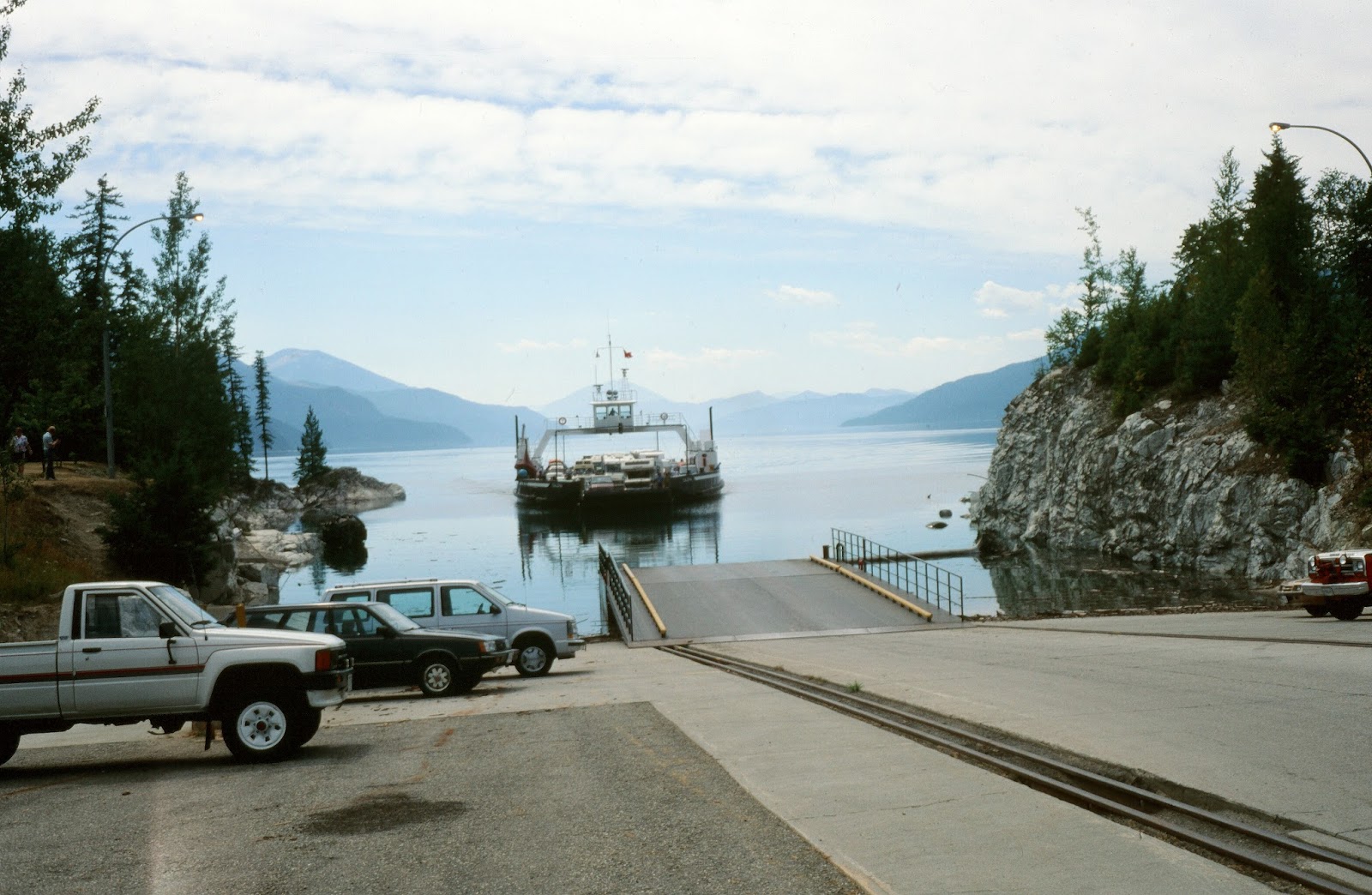
Upper Arrow Lake, British Columbia, Canada, one of two where the few residents and occasional visitors used steamboats to access the shores. It took hours or days to reach a settlement along the lakes, and some boats were equipped with overnight facilities. The Upper Arrow lake shown has a ferry service today but the lower lake still is difficult to access. The ferry shown is a short distance south of Revelstoke.
To write an interesting story about the Arrow Lakes in the book The Columbia River, I interviewed retired ship captains and passengers. The local stories make a travel book draw a reader into the sites in a far more personal manner than just writing about time tables, physical description of a site, or the management details. Through the eyes of "John Smith" the reader is transported into the site mentally and emotionally.
Yet it is true that travelers want to know where to eat or stay, and such necessary details. My publisher dealt with such mundane matters by suggesting four chapters in the book of "Travel and Trivia" to avoid cluttering up the historical text. As a writer it was necessary to investigate personally the details of an area so that the book would suggest suitable sites. This meant, as well, that the book inevitably would need occasional updating . I pointed out the story of a 1200+ river in one book would need care in making real the tales of its past. Siphoning off practical information achieves this and often identifies other books that may focus on topics of a reader's particular interest .For us the writers it is important to keep a main theme flowing smoothly.
To write an interesting story about the Arrow Lakes in the book The Columbia River, I interviewed retired ship captains and passengers. The local stories make a travel book draw a reader into the sites in a far more personal manner than just writing about time tables, physical description of a site, or the management details. Through the eyes of "John Smith" the reader is transported into the site mentally and emotionally.
Yet it is true that travelers want to know where to eat or stay, and such necessary details. My publisher dealt with such mundane matters by suggesting four chapters in the book of "Travel and Trivia" to avoid cluttering up the historical text. As a writer it was necessary to investigate personally the details of an area so that the book would suggest suitable sites. This meant, as well, that the book inevitably would need occasional updating . I pointed out the story of a 1200+ river in one book would need care in making real the tales of its past. Siphoning off practical information achieves this and often identifies other books that may focus on topics of a reader's particular interest .For us the writers it is important to keep a main theme flowing smoothly.
Tuesday, April 5, 2016
#5/ ARTICLES AND BOOKS NEED PHOTOS, TOO
Saturday, March 26, 2016
HOW I WRITE A BOOK #4
STOLEN CHURCH NOW IN WINDERMERE
As I approached the next leg of writing a book, based on the Columbia River book mostly, I was so amused at the tale of how this church was stolen, literally. I thought it important to tell you that photos and odd tales mixed in with the facts make a book steeped in history actually readable. I never was much on writing about what happened somewhere in terms only of who was the governor, what treaty was made, and such. Frankly, one needs to have such details but as a fact on which to tell the story of the "real people," as I call them. I like to tie local lore into the book as a means of transporting the reader to the site I am describing.
In this case, the St. Stephens Church at the little town of Donald on the CPR (on the Rogers Pass segment from Golden to Revelstoke) was the site of the charming little church that served mostly the workers and families. CPR started to move its headquarters to Revelstoke, west of Donald, the opposite side of the pass, In the dark of night parishioners of St. Stephens loaded the entire church onto a flat car and took it to Windermere, where it still rests. The angry CPR managers were unable to persuade the locals to give it back. For book purposes I could have just said that the church was moved to Windermere, but the real cloak-and-dagger method makes the event memorable. This tale was common local knowledge, but sometimes one can find lively and little-known tidbits in the loose files of the local town libraries.
Similarly, the old highway around the north end of Lake Kinbasket (part of the Columbia River) was under water in early days of high water. It is more interesting to understand how pioneers dealt with misfortune when we add to the book that well-known settler Gordon Bell traveled that stretch of road. in 1960 by removing the fan belt and slogging through as much as two and one-half feet of water. He was hauling necessary equipment for the construction of the still-popular hotel Three Valley Gap. Such small things make the book reader a part of the struggle, not a detached collector of facts.
In my writing of this segment of Columbia River I set out at the broad meeting of the three rivers that join to turn southwesterly in a leaky little boat. The snow-covered Columbia Ice Field peaks loomed above my 10-foot craft, a precarious short ride. I had learned in the research files that this original narrow defile claimed the lives of many early explorers. .. And here I was in that spot, albeit a much larger body of water, in a way too small boat. Hmmmm.
Saturday, March 12, 2016
How I Write a Book, #3
Spring in My Garden
BUT I AM WRTING A BOOK....
The publisher has stated that I have one year to write the book about the Columbia River, 1200+ miles long, so I divide the preparation into 100 miles a month. The topic covers too much area to absorb the feeling of the whole river at once. I go to the first 100 miles of river for two weeks, then go back to my office, write for two weeks, and on to the next 100 miles.
During each research of two weeks on site I do not try to write finished text. I visit the local library or any other local source of pertinent information and take notes, make copies, record the ambiance of the place, get the area's relationship to the entire river's history as I then know it roughly, interview many people and get their signed clearances to use material (if needed) and any photographs of people (must have to meet today's rules).
I gather and double-check any information that is scheduled for some books, such as places to stay, eat, visit as a tourist, and any advice for visitors if that is the type of armchair history you are writing. Double-check all these details and determine, as much as you can, if the information will be about the same within the coming year or two. From this first day of writing about something to the issuance for the public (bookstores, signings, etc.) will take about 1-2 years.
For the book Colunbia River I learn and record matters. When was the river discovered by Europeans or any person or group that recorded this in some language (French, Russian, English, ?). Find a First Nations person to see if earliest data is known about how the river was used or homes built near there, what the people did to support themselves (fish, grow crops, ?) Determine the exact site of the river's birth, photo if possible. What does it do then -- run into a pond, river, lake, or wind around. How wide is it? Interesting tidbits, which are crucial to creating a book that has some life and not just statistics and hard information, e.g., the CR runs through a golf course now, so imagine teeing off over the CR, because at its beginning it is just a stream no wider than your street, perhaps, and near the ocean is four to six MILES wide. Another interesting squib might be that many people do not know that the CR runs northwest for a great distance before it turns south and eventually west. I work this into a narrative that makes readers feel they are there in person. Mentally, when I am writing the book, I AM there.
See you again at approximately mile 101 downstream in blog 4.
JoAnn Roe
Subscribe to:
Posts (Atom)