Wednesday, June 22, 2016

ODD MOMENTS IN WRITING OR RESEARCH

The last research for the Columbia River book was at the entrance of the river into the Pacific Ocean. What happened there was frequently chaotic, because the river's strong currents collided with powerful ocean waves. Many ships have been lost at this entrance near Astoria, Oregon, especially in earlier days of exploration. The narrow spit south of the entrance still shows remnants of ships and/or are described in the museums near or just inside the mouth of the Columbia. I described one amazing  event in my book.

In 1991, the survivors of a tragic accident at the Columbia's Bar that had claimed seven men and four boats on the same exact day in 1961 gathered to honor the dead in Astoria. I was interviewing them when we were told that a similar accident was under way on the Bar. The 75-foot trawler sank, two men died and one was missing, and seven others were rescued from the chilly waters. In both incidents professional Coast Guard rescue boats and crews were among the victims.  All this on the exact day and place 30 years apart!

Another time, another book, I searched fruitlessly for anyone who might have witnessed an event. Not long afterward on a major airline  I found the right man sitting next to me on the flight!

During book signings, a more likely source of information, of course, visitors appeared frequently who had experienced some event about which I had written.  '


Monday, May 16, 2016

#6 of HOW TO WRITE A BOOK -- ORGANIZE.

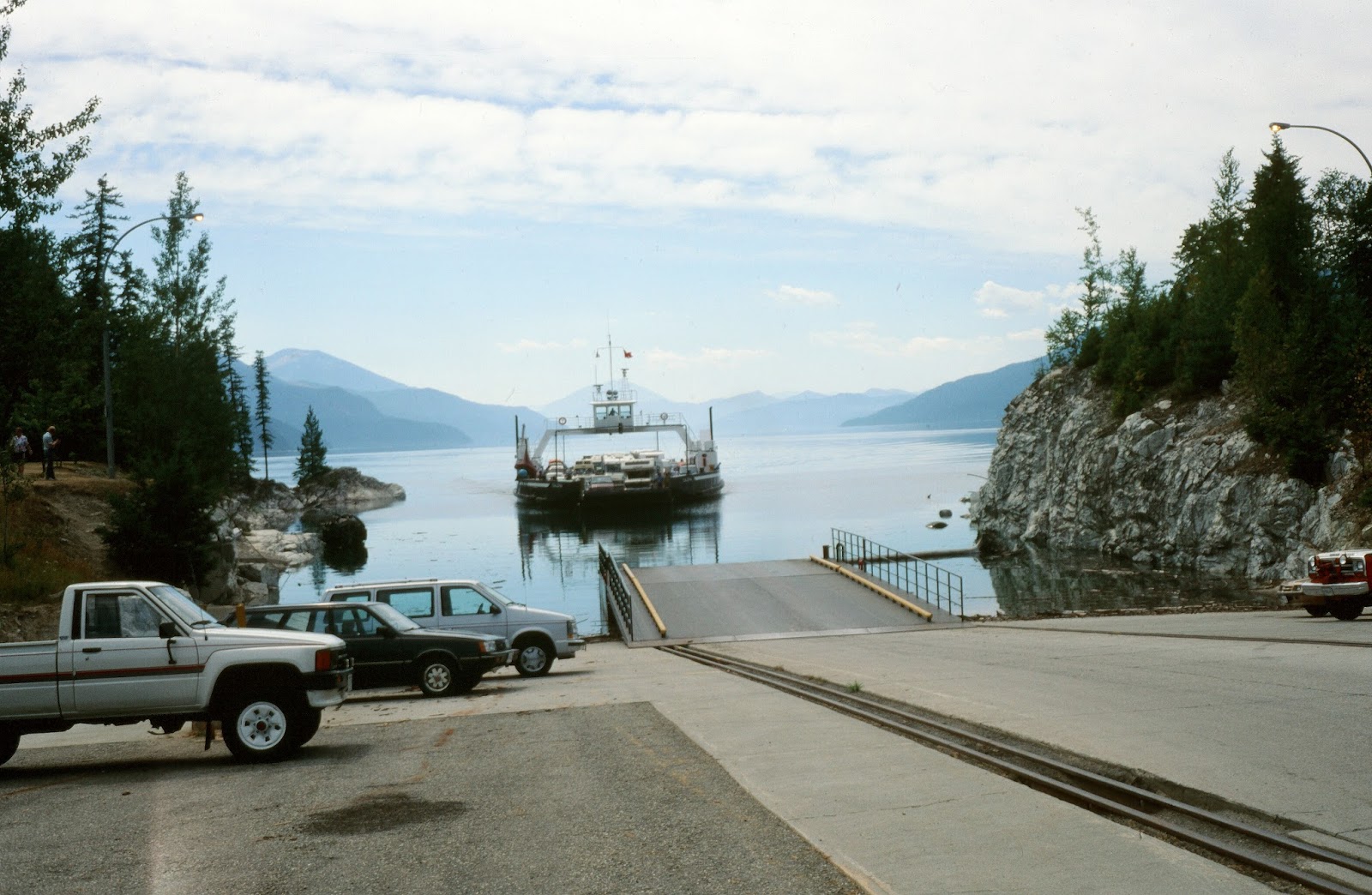
Upper Arrow Lake, British Columbia, Canada, one of two where the few residents and occasional visitors used steamboats to access the shores. It took hours or days to reach a settlement along the lakes, and some boats were equipped with overnight facilities. The Upper Arrow lake shown has a ferry service today  but the lower lake still is difficult to access. The ferry shown is a short distance south of Revelstoke.

To write an interesting story about the Arrow Lakes in the book The Columbia River, I interviewed retired ship captains and passengers. The local stories make a travel book draw a reader into the sites in a far more personal manner than just writing about time tables, physical description of a site, or the management details. Through the eyes of "John Smith" the reader is transported into the site mentally and emotionally. 

Yet it is true that travelers want to know where to eat or stay, and such necessary details. My publisher dealt with such mundane matters by suggesting four chapters in the book of "Travel and Trivia" to avoid cluttering up the historical text. As a writer it was necessary to investigate personally the details of an area so that the book would suggest suitable sites. This meant, as well, that the book inevitably would need occasional updating . I pointed out  the story of a 1200+ river in one book would need care in making real the tales of its past. Siphoning off practical information achieves this and often identifies other books that may focus on topics of a reader's particular interest .For us the writers it is important to keep a main theme flowing smoothly.

Tuesday, April 5, 2016

#5/ ARTICLES AND BOOKS NEED PHOTOS, TOO

Roe basking in the Canadian sun before going off to research Columbia Lake.

So far I have talked about writing a book. In today's world a writer needs to become proficient with photography, too. In my case, I took lessons in Los Angeles and Hollywood in how to take good photos and also adjust the film in Photoshop or the program that comes with your camera's picture storage. In more advanced photo adjustment one sometimes wishes to take out a tree or some object on the image, .One time I photographed a horse and did not notice until I printed the image that he had five legs because of a post behind him. Obviously , this was OK, but -- in some cases -  clients (magazines, newspapers,some books and contests) view tampering with your image not popular or simply to be prevented, especially images with scenery. Color and saturation matters, straightening the image, and such are often desirable. It's sort of like cleaning your house before the guests arrive.

Today's cameras are so universally excellent that one can scarcely take bad images, but do take some instruction in the ART of pictures, the mood of the images, is the scene to stay far off or should you take a closer view. If so, you may need to use a tripod or set the camera on a fixed surface. Adjusting our camera to move in on an image with more detail can result in fuzzy images if you do not  control all movement of the camera.

The old saying is that a picture is equal to a thousand words may be the case, especially for moving subject such as a train, sports figure, animal flight, and you should be sure to set your camera for the intended image -- even though many cameras, even inexpensive ones, do include an anti-motion factor.  Sometimes control of the movement helps the image. I recall a photo taken in Patagonia of a closeup cow and calf running past me very fast, where leaving a modest blur of speed across the printed image was a plus.

In this section of the Columbia River we are now researching, grizzly bears are common but the rushing water of the river itself may be the close focal point to match its deep canyon, very swift passage.  Try it both ways. Why not -- all you need to do is delete a digital image if you don't think the image "says anything."

Saturday, March 26, 2016

HOW I WRITE A BOOK #4


                                            STOLEN CHURCH NOW IN WINDERMERE
As I approached the next leg of writing a book, based on the Columbia River book mostly, I was so amused at the tale of how this church was stolen, literally. I thought it important to tell you that photos and odd tales mixed in with the facts make a book steeped in history actually readable. I never was much on writing about what happened somewhere in terms only of who was the governor, what treaty was made, and such. Frankly, one needs to have such details but  as a fact on which to tell the story of the "real people," as I call them. I like to tie local lore into the book as a means of transporting the reader to the site I am describing.

In this case, the St. Stephens Church at the little town of Donald on the CPR (on the Rogers Pass segment from Golden to Revelstoke) was the site of the charming little church that served mostly the workers and families. CPR started to move its headquarters to Revelstoke, west of Donald, the opposite side of the pass, In the dark of night parishioners of St. Stephens loaded the entire church onto a flat car and took it to Windermere, where it still rests. The angry CPR managers were unable to persuade the locals to give it back. For book purposes I could have just said that the church was moved to Windermere, but the real cloak-and-dagger method makes the event memorable. This tale was common local knowledge, but sometimes one can find lively and little-known tidbits in the loose files of the local town libraries.

Similarly, the old highway around the north end of Lake Kinbasket (part of the Columbia River) was under water in early days of high water. It is more interesting to understand how pioneers dealt with misfortune when we add to the book that well-known settler Gordon Bell traveled that stretch of road. in 1960 by removing the fan belt and slogging through as much as two and one-half feet of water. He was hauling necessary equipment for the construction of the still-popular hotel Three Valley Gap. Such small things make the book reader a part of the struggle, not a detached collector of facts.

In my writing of this segment of Columbia River I set out at the broad meeting of the three rivers that join to turn southwesterly in a leaky little boat. The snow-covered Columbia Ice Field peaks loomed above my 10-foot craft, a precarious short ride. I had learned in the research files that this original narrow defile claimed the lives of many early explorers.  .. And here I was in that spot, albeit a much larger body of water, in a way too small boat.  Hmmmm.


Saturday, March 12, 2016

How I Write a Book, #3

Spring in My Garden
BUT I AM WRTING A BOOK....
The publisher has stated that I have one year to write the book about the Columbia River, 1200+ miles long, so I divide the preparation into 100 miles a month. The topic covers too much area to absorb the feeling of the whole river at once. I go to the first 100 miles of river for two weeks, then go back to my office, write for two weeks, and on to the next 100 miles.

During each research of two weeks on site I do not try to write finished text. I visit the local library or any other local source of pertinent information and take notes, make copies, record the ambiance of the place, get the area's relationship to the entire river's history as I then know it roughly, interview many people and get their signed clearances to use material (if needed) and any photographs of people (must have to meet today's rules). 

I gather and double-check any information that is scheduled for some books, such as places to stay, eat, visit as a tourist, and any advice for visitors if that is the type of armchair history you are writing. Double-check all these details and determine, as much as you can, if the information will be about the same within the coming year or two. From this first day of writing about something to the issuance for the public (bookstores, signings, etc.) will take about 1-2 years.

For the book Colunbia River I learn and record matters. When was the river discovered by Europeans or any person or group that recorded this in some language (French, Russian, English, ?). Find a First Nations person to see if earliest data is known about how the river was used or homes built near there, what the people did to support themselves (fish, grow crops, ?)  Determine the exact site of the river's birth, photo if possible. What does it do then -- run into a pond, river, lake, or wind around. How wide is it? Interesting tidbits, which are crucial to creating a book that has some life and not just statistics and hard information, e.g., the CR runs through a golf course now, so imagine teeing off over the CR, because at its beginning it is just a stream no wider than your street, perhaps, and near the ocean is four to six MILES wide.  Another interesting squib might be that many people do not know that the CR runs northwest for a great distance before it turns south and eventually west. I work this into a narrative that makes readers feel they are there in person. Mentally, when I am writing the book, I AM there.

See you again at approximately mile 101 downstream in blog 4. 

JoAnn Roe


Sunday, February 28, 2016

HOW I WRITE A BOOK #2


In the last blog I clarified the procedure of contracting with a publisher or preparing myself to begin writing,    Not all authors prepare the same way, for sure.  I will focus on how I wrote The Columbia River in this series of blogs.

I head off by car for the headwaters of the Columbia north of the Canadian border in eastern British Columbia, a long day's trip. I bring no notebook and may avoid bringing my serious camera, too. I am going to wander along the river and environs to begin feeling the river. It's like immersing myself in its waters, absorbing the surroundings, making the river live inside me. I chat with people I encounter with small talk mostly, not asking questions often. I am simply transporting my mental self to the site on the Columbia that I am physically standing on. Often I am imagining what I would be doing and thinking if "now" had been "then," historically decades or years earlier.

As the days pass, I continue to soak up the ambience of the area and of the river itself, its currents, clear or murky, water color,  fast or slow, plants, sounds of the river and the plunk plink of a fish jumping, small animal cries.  As the creation of the book progresses,  I will spend time in advance of ongoing writing to understand from the river's standpoint  what may be at each new block of geography.

I do not write anything down on this first trip. I merely concentrate on every aspect of the river's life at a particular location. I am blessed with the ability to store visual images and impressions for some time when I am deliberately focused on taking in everything 360 degrees around me.

I return home to simply think about what I have absorbed and plan on a direction for my work to proceed. I resume my normal life with husband and social friends and rest. Within one week I return to the beginning site. Thus, each week required two days of travel, going and coming.


Monday, February 15, 2016

HOW I WRITE A BOOK

  • HOW I WRITE A BOOK
So many readers ask me how I go about writing a book. Most people who are not writers really do not know about the procedure. I think many authors follow  a process similar to mine, except for the many, many self-published authors that are able to put their works into the market today. However, as a lifetime professional writer, I have been lucky enough (or at least was known a little bit because of my lengthy career writing for magazines) to have most of my prospective books contracted in advance by traditional publishers.

What is the difference? A traditional publisher receives suggestions for a book from writers like me. The very largest of such publishers only read inquiries (usually) presented by an agent; Most  others do read proposals from almost anyone, who usually must research the publishing firm to get some idea of how many books a year it publishes, the readers that it tends to attract (fiction, non-fiction, adventure, romance, etc.), acceptable formats, what its pay schedule is for advances and royalties. The contract is very important to both parties. One must be sure the subject is not already in print, at least with the same slant the author chooses, that direct quotes from any person or other book have signed releases,  what are the term of subsidiaries, and the due dates for a contracted manuscript (very important because publishers advertise books greatly in advance), plus other matters. Subsidiaries are very important, because the income split for a book made into a movie or other use, for foreign language version, and other types of reproduction varies between publisher and author.. A host of other variable matters between publisher and author need discussion, as well.

Once the contract is signed, the publishing company pays all the costs of the formatting, publishing, distribution to wholesalers and distributors, promotion and other marketing costs. The author pays the costs of writing an acceptable finished manuscript and furnishing illustrations (usually).  Please understand that I do not assume responsibility for any form of error or variation that the author or publisher incurs from following my comment on this publishing and sale process. I am merely generalizing from experience at writing 17 published books to date.

Traditional publishers include such large and small companies as Random House, McGraw-Hill, Harper's, Caxton Press, Rowman & Littlefield, Peachtree Children's Press.

Self-publishing requires the authors, organizations, a small corporation , "whoever," to pay for all the costs involved in publishing and marketing the book. A whole new cadre of marketers is appearing to assist in the marketing and sale of such books, often written by first-timers in the field and well-written as any but needing to build a recognition factor. One needs to be aware of the way the system works, such as establishing a retail price, upon which most percentages of sale are built, such as to bookstores, wholesalers, the public at book shows, etc., in order to set a figure that will permit a profit over publishing and marketing expenses. Some publishers ask for the author to contribute a percentage of the over-all costs in a joint agreement. As indicated above, I do not guarantee that any advice given above is totally correct or up to date I am generalizing. See your attorney or a knowledgeable writing coach, at least.

NEXT BLOG: Now that we have some background out of the way, the blog can deal with more interesting details such as how I approach the writing process. See ya.